
A meteorite dial is a slice of iron that spent four billion years in space before it was cut thin enough to put hands on. Here is what the pattern actually is, why it cannot be faked, what to know about owning one, and why I put it on the Vessel first.
What you are looking at
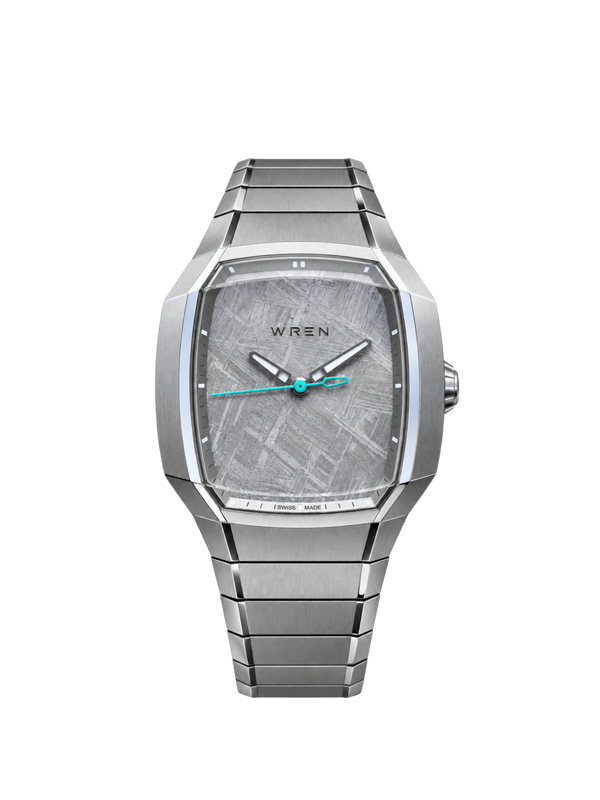
The crosshatch on a meteorite dial is called the Widmanstätten pattern, after the Austrian who first noticed it in 1808. It is not a surface finish. It is the crystal structure of the metal itself, running all the way through the slab.
Iron meteorites are the cores of small planets that broke apart early in the solar system. The core was molten iron and nickel, and it cooled inside the body at something like one degree every million years. At that speed the two metals had time to separate into two different crystals, kamacite and taenite, which grew as interlocking plates along the faces of a single huge octahedral crystal. A cooling rate that slow cannot be reproduced. There is no furnace on earth that can hold a temperature for a million years, so no foundry has ever made the pattern. Every meteorite dial is a piece of an actual asteroid core, and the pattern is the proof.
Wren's dials are cut from the Muonionalusta meteorite, which fell in the far north of Sweden about a million years ago and was found in 1906. The iron is sliced into sheets well under a millimeter thick, flattened, and then acid treated. The two crystals corrode at different rates, so the plates stand out from each other and the lattice appears. The acid is what makes the pattern visible, and it is also what stabilizes the surface, so the dial needs nothing from you afterward.

Why no two are the same
The plates run in four directions through the parent crystal, and a slice cuts across them at a different angle every time. Change the angle of the cut and the bands go from wide ribbons to tight needles. Move a few millimeters along the slab and the pattern shifts again. Two dials from the same meteorite, cut from neighboring slices, do not match. This is why the number on a Vessel Meteorite caseback is also the number of a dial that exists once.

What to know about owning one
It is brittle compared with brass, which is what dials are usually made of. Slices crack during cutting, and the ones that survive still crack when the feet are fitted or the holes are drilled. The yield on a batch of meteorite dials is worse than on any other dial Wren has made, which is part of why the Meteorite costs $500 more than the Sunray. Once it is in the case, it is as durable as any other dial.
And it shifts with the light. The etched plates are tiny angled surfaces, so the pattern flares in one direction and goes dark in another as you turn your wrist. Photographs flatten this, which is why a meteorite dial always looks better in person than on a product page.

Why it works on the Vessel
I wanted Wren's first stone dial to be on a special watch, not a variant of something we already made. The Vessel is that watch, and the dial is there for three reasons.
The first is the brief. Max Resnick and I set out to design a watch for 2075 rather than 1975, and somewhere in the two years of sketches it stopped being a watch that looked futuristic and became, quite literally, a tiny spaceship on your wrist: a faceted hull, a crystal cut like a canopy, a bracelet that locks into the case like it was machined as one piece. A ship like that gets one dial. Iron from an asteroid core is the only material that belongs inside it, and it is the one part of the Vessel that was not drawn. It is older than the planet the rest of the watch was made on.
The second is that the crystal and the dial are the same idea. The Vessel's sapphire is faceted on top and faceted again underneath so the dial reads without distortion. Sapphire is a single grown crystal. The meteorite is a single grown crystal too, just one that took a few hundred million years longer. Under a faceted crystal the plates in the dial and the planes in the sapphire catch the same light, and the watch reads as one object rather than a case with a dial in it.
The third is that the dial is the test the crystal has to pass. A plain dial hides distortion. A sunray dial mostly hides it. A lattice of straight lines running under the facets at twelve and six shows every bend. If the underside of the crystal had been cut flat, the way the first prototypes were, the pattern would have kinked at the edge of each facet. It does not. The Meteorite is the version of the Vessel that proves the crystal works, and the aqua seconds hand, carried over from the Diver One Aqua, gives the eye one point of color to track across it.

The Meteorite was the first Wren to sell out in two weeks. I think that is why.
Questions people ask
Is a meteorite dial real meteorite? Yes. The Widmanstätten pattern only forms in iron that cooled over millions of years inside an asteroid, and it cannot be produced in a foundry. A dial with that pattern is a slice of the real thing.
Where does the Wren meteorite come from? Muonionalusta, in northern Sweden. It fell about a million years ago and is roughly four and a half billion years old.
Why does my meteorite dial look different from the photos? Because the pattern is etched into angled crystal plates, so it changes with the light and with the angle of the cut. Every dial is different and every dial looks different through the day.
Does a meteorite dial need any care? No. The acid treatment that reveals the pattern also stabilizes the surface, and the dial lives inside a sealed case. Treat the watch as you would any other.
Are meteorite dials fragile? The slice is brittle and cracks easily during manufacturing, which is why yields are low and the watches cost more. Once cased, it is as durable as any other dial.
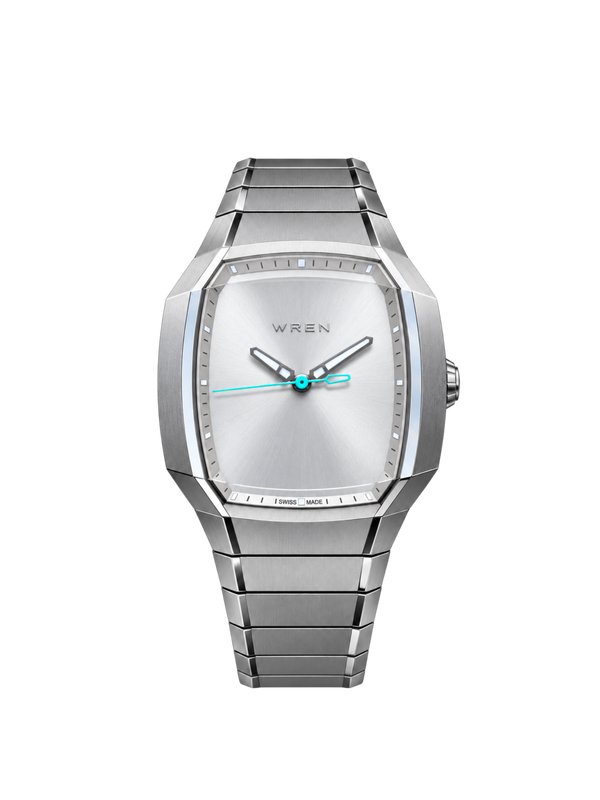
Is the Vessel Meteorite still available? The first 150 sold out in 14 days. The Vessel Sunray, the same watch with a steel sunray dial, is available on preorder.
Read next
Sapphire crystals, explained · Why faceted crystals distort the dial, and how the Vessel doesn't · Five in a hundred