
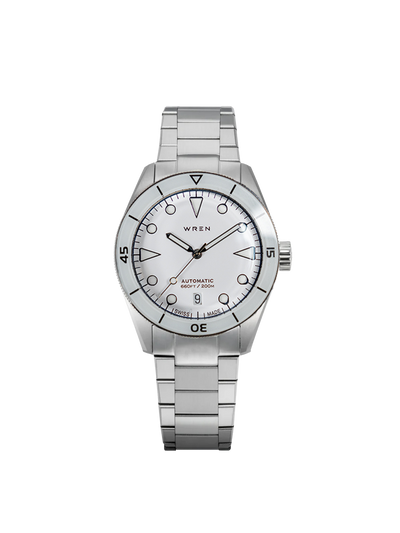
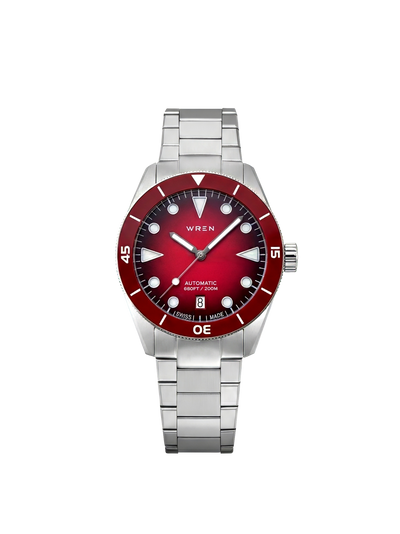
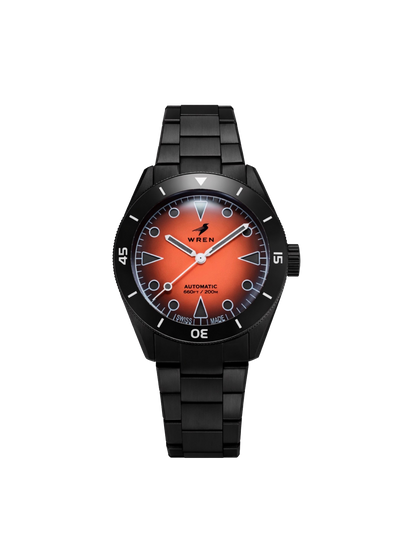
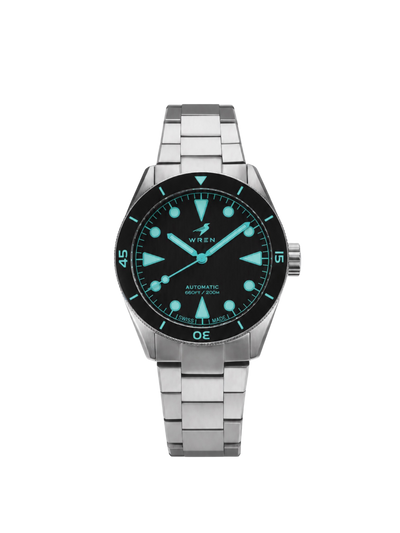
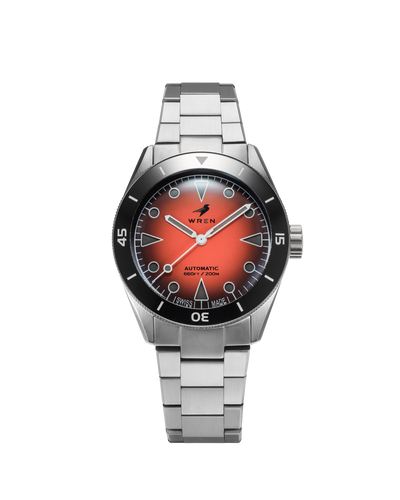
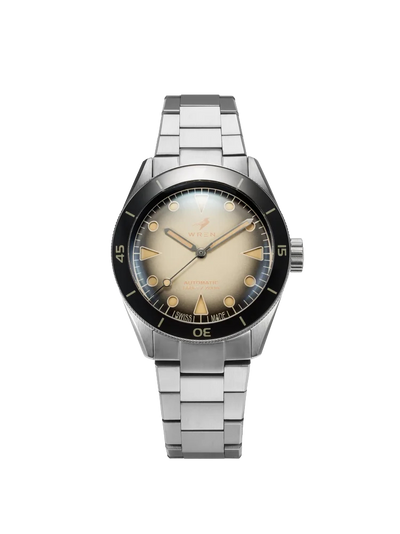
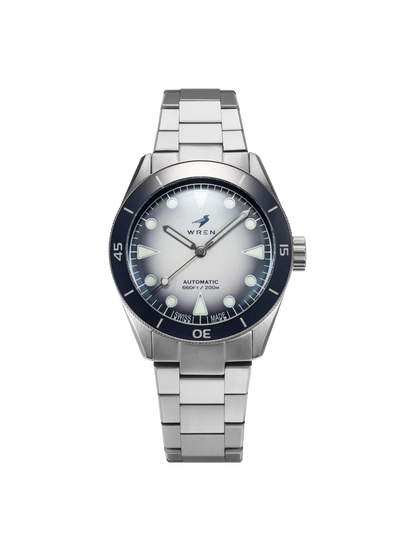
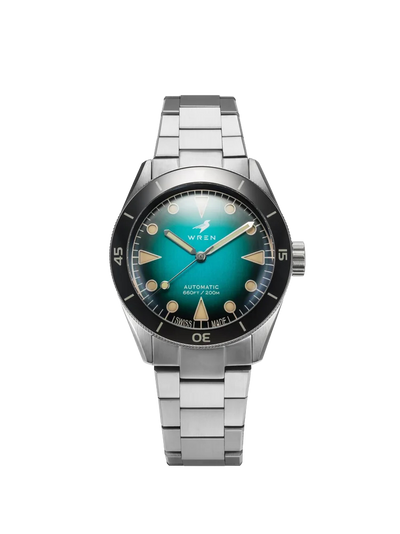
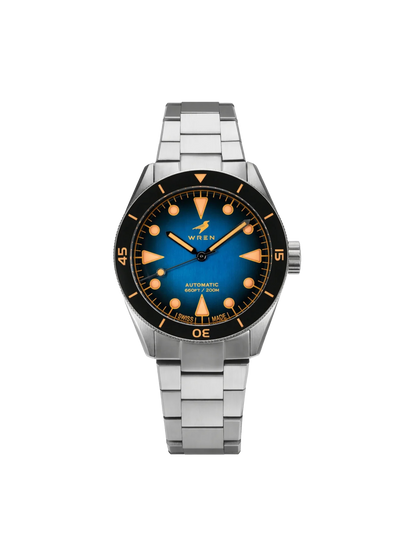
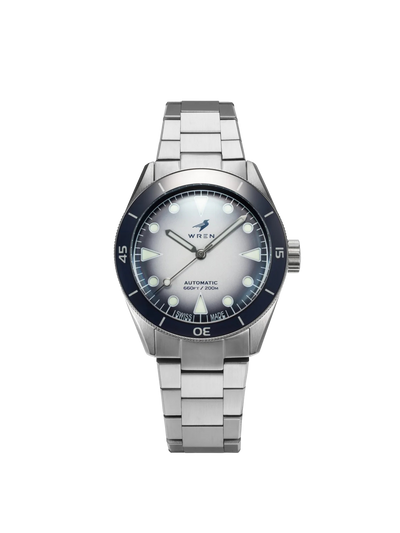

Facet the top of a sapphire crystal and leave the underside a smooth dome, and the dial warps wherever a facet crosses it. The Vessel cuts the underside to match the top. This note explains what a facet does to light, why the usual construction distorts, and what Wren did differently.
What a facet does to light
A flat or domed crystal bends light the same way across its whole surface, so the dial underneath looks the way it is. A facet is a break in that surface: a second plane, tilted away from the first, meeting it at an edge. Light crossing that edge enters the sapphire at a different angle on one side than the other. If nothing on the underside corrects for it, the light on the two sides of the edge exits toward your eye from two slightly different places on the dial. Whatever sits under the facet appears shifted, stretched, or doubled, and the effect changes as the wrist turns.
That is not a flaw in the cutting. It is what refraction does when the top of a crystal and the bottom of a crystal are two different shapes.
The usual way: faceted on top, domed beneath
Almost every faceted watch crystal is made the same way. The facets are cut into the outer surface, where you can see and admire them, and the inner surface is left as a simple dome or a flat, because that is cheap and reliable to make. The result looks striking from straight on and distorts everywhere else. The hour markers that sit under the facets split or smear as you tilt the watch. Reviewers call it character. It is, more precisely, a trade: the facet you can see in exchange for a dial you cannot always read.
The Vessel: the negative underneath
The Vessel's crystal is faceted across twelve and six on its outer surface, and those facet edges curve rather than run straight. Then the underside is cut again, with the same facets, as the negative of the top. Light that enters through a facet leaves through its matching facet, so the bend on the way in is undone on the way out. The dial reads true from any angle, including the angles where a faceted crystal normally gives itself away.
There are no facets at three and nine. The architecture runs top to bottom only, which is what gives the watch its profile on the wrist and why the markers at twelve and six are the ones that matter.
Watch the twelve and six markers
This is the test you can do in a shop. Hold any faceted watch flat, then tilt it toward you and away from you and watch the marker at twelve. On a crystal that is faceted only on top, the marker steps sideways or splits as the facet passes over it. On the Vessel it does not move. The whole point of cutting the underside is that there is nothing to see.
Why nobody had done it
Because it is very hard to make. Our first prototypes had curved facets on top and a straight-cut underside, and came back with five usable crystals out of a hundred. When we asked for the underside to follow the top, the manufacturer declined, and so did every other sapphire house we approached. The one that eventually agreed makes sapphire cases rather than crystals, and was used to cutting the material in three dimensions. Production now runs at roughly four good crystals in five. The crystal costs more to make than the Swiss movement behind it, which is backwards at this price and is the reason the watch exists. The story of how it got made is in Five in a hundred.
To our knowledge the Vessel is the first production watch whose sapphire crystal is faceted and curved on both surfaces of the same crystal, with the underside cut as the negative of the top. Curved crystals, faceted outer surfaces and sculpted undersides have each appeared before on their own. Putting all of them into one crystal, with the inner geometry following the outer, is what had not been done.
Questions people ask
Does a faceted crystal distort the dial? On a crystal faceted only on the top surface, yes, at the facet, and more so as the viewing angle changes. On the Vessel, no, because the underside is cut to match.
Is the Vessel crystal domed or flat in the middle? The central panel is flat on top and flat underneath. The facets sit across the top and bottom of the dial, and both the top and underside facet edges curve.
Does cutting the underside weaken the crystal? No. The crystal is sapphire throughout and the case is rated to 70 meters. What the underside cut costs is yield in manufacturing, not strength in use.
Is there an anti-reflective coating? Yes, on the underside. Coating the inner surface keeps reflections off the dial without putting a coating on the outside where it can scratch.
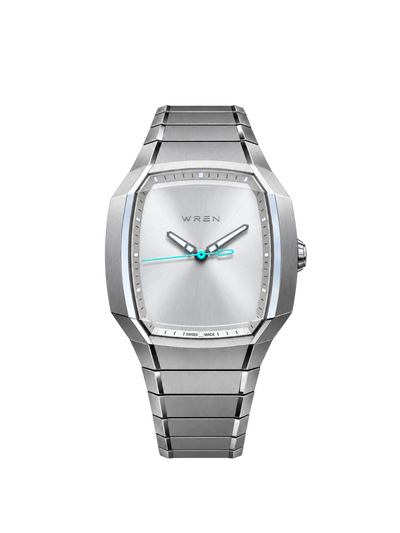
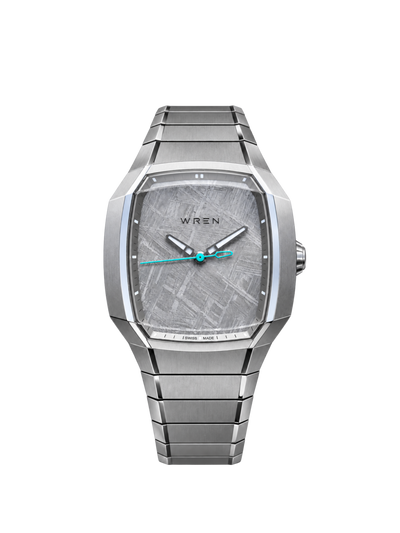
Which watches have it? The Vessel Sunray and the Vessel Meteorite, 150 pieces each, individually numbered.
Read next
Five in a hundred: the crystal almost nobody would make · What 200 meters of water resistance actually means