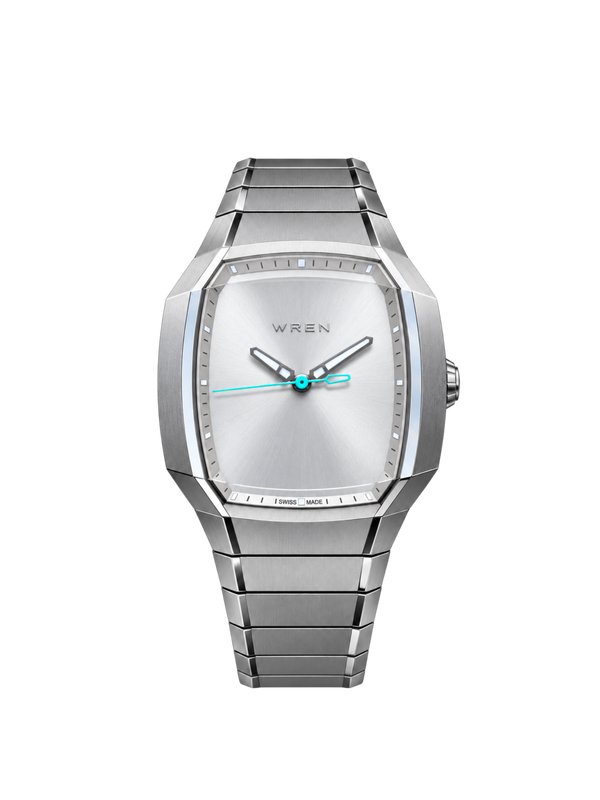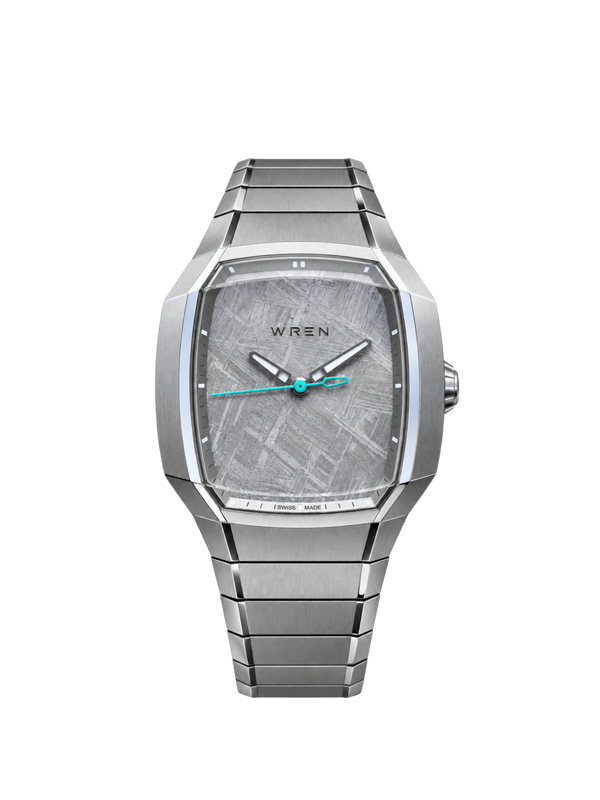
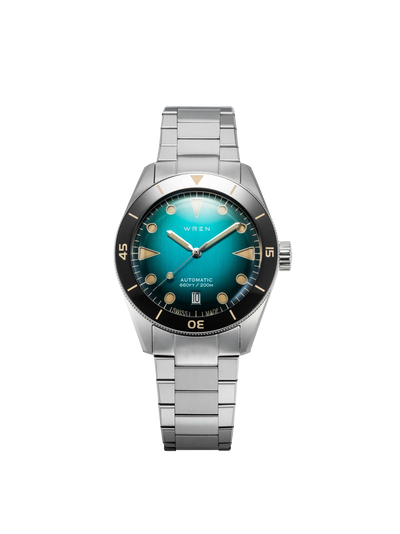
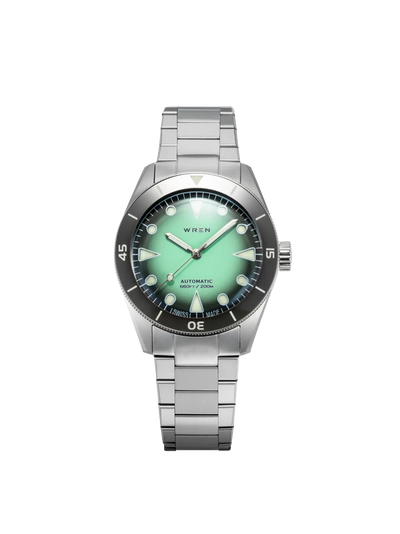
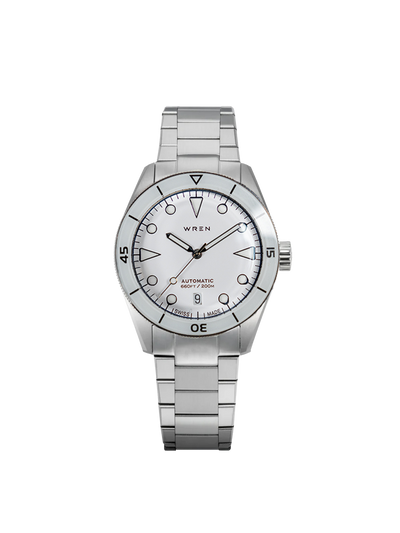
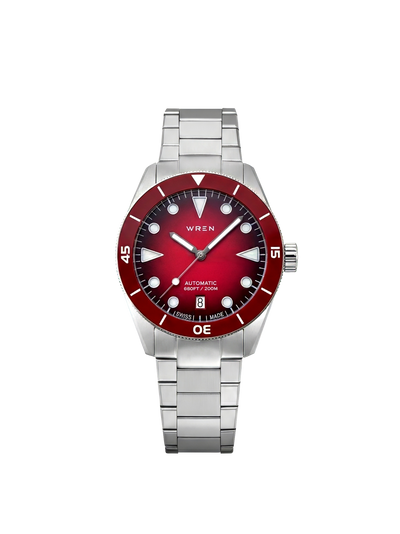

The material gets all the attention. The shape is what you actually see.
Almost every watch you will consider is sapphire, so the material is settled. What is not settled, and what changes how the watch looks, how thick it is and how it ages, is the shape of the crystal. A flat crystal is the thinnest and the most honest about the dial, a domed crystal bends light and adds vintage warmth, a box crystal stands up off the case with straight sides like an old acrylic, and a faceted crystal is cut into planes like a gemstone. Each one is a trade: height against character, clarity against glow, cost against how much of the watch is made of the crystal. Here is what each shape does, and which one is on which Wren.

Flat
A flat crystal is a disc of sapphire with parallel faces, usually sunk slightly below the bezel. It is the thinnest option, typically 1 to 2mm, and it adds nothing to the height of the watch beyond its own thickness. Light passes straight through it, so there is no distortion at any angle and anti-reflective coating works at its best, which is why most modern tool watches and almost every thin watch uses one. The bezel protects its edge, so it is also the hardest to chip.
What it gives up is personality. From the side a flat-crystal watch is a slab, and the dial can look like it is printed on glass rather than sitting under it. If you want the thinnest possible watch or the clearest possible view of a complicated dial, flat is the right answer. If you want the watch to look like anything from before 1980, it is not.
Domed
A domed crystal curves upward. The first question to ask is whether it curves on one side or both, because that decides everything about how it behaves.
A single-domed crystal is curved on the outside and flat on the inside. That makes it a lens. Look at the dial straight on and it is fine; tilt the watch and the edge of the dial stretches and swims, and the crystal throws a bright reflection that AR coating only partly tames. Brands use it because it is cheaper to make than a double dome and it gives the vintage silhouette at a glance.
A double-domed crystal is curved on both surfaces, so the inside follows the outside and the lens effect mostly cancels. You keep the shape from the side and lose most of the distortion. It is the shape to want if you want a dome. It costs more because the inner curve has to be ground and polished too, and because the walls get thin where the two curves meet, so the sapphire has to be thicker in the middle to compensate. That is where the extra height comes from: a double dome usually adds 1 to 1.5mm to the watch over a flat crystal.
Domes also decide where the watch gets hit. A crystal that stands above the bezel is the first thing to meet a door frame, and sapphire does not scratch but it does chip at an exposed edge. A domed crystal on a diver with a tall bezel is protected; the same dome on a dress watch with no bezel is not.
Box
A box crystal, sometimes called a glass box or a box sapphire, is a dome with vertical walls. Instead of curving up from the bezel it rises straight, like a short cylinder, and then flattens or gently domes across the top. The shape comes from the acrylic crystals on 1960s and 1970s sport watches, which were molded that way because that was the easy shape to mold. Doing it in sapphire means grinding the walls and the top out of a single blank, which is slower and more expensive than a dome.

The reason to pay for it is the view from the side. A box crystal catches light along its straight edge and you can see the dial through the wall, which is the look most people are responding to when they say a watch looks vintage without knowing why. Straight on, a good box crystal is close to a flat crystal, because the top surface is nearly flat and the inside is cut to match. The distortion lives in the walls, where you only see it when you are looking at the watch from the side, which is exactly where you want some.
The price is height. The walls add between one and two millimeters, and on a watch that is already engineered thin that is most of the budget. The second price is that the walls are exposed above the bezel and will take a hit before anything else on the watch does. A box crystal on a dive watch sits inside a bezel that is only a little lower than it is, so it is reasonably protected; on a watch with no bezel it is the highest point.
Faceted
A faceted crystal is cut into flat or curved planes, the way a stone is cut for a ring. Almost nobody does this on a production watch, for two reasons. The first is cost: every facet is a separate grinding and polishing operation on a material that is nearly as hard as diamond. The second is that each facet acts as its own lens, so a crystal faceted only on the outside turns the dial into a hall of mirrors the moment you tilt it. The watches that have tried it have mostly accepted the distortion as part of the design.

The way around it is to cut the inside as well, so that each outer facet has a matching inner facet behind it and the light path through the crystal stays parallel. That doubles the work and it is the reason faceted crystals are rare. When it is done, the result is a crystal that reads as a shape from across the room and as a clear window up close. We wrote a separate piece on why faceted crystals distort the dial, and how the Vessel does not.
How the four compare
- Height added over a flat crystal: flat, none; double dome, about 1 to 1.5mm; box, about 1 to 2mm; faceted, depends entirely on the cut.
- Distortion straight on: flat, none; single dome, little; double dome, little; box, little; faceted, none if the inside is cut to match, severe if it is not.
- Distortion at an angle: flat, none; single dome, a lot; double dome, little; box, in the walls only; faceted, as above.
- Reflections: flat, least, and AR works best; domes and boxes, more, because a curved surface always finds a light source; faceted, most, by design.
- Chip risk: flat, lowest; domes and boxes, higher wherever the crystal stands above the bezel; faceted, the edges between facets are the exposed points.
- Cost: flat, least; single dome; double dome; box; faceted, most.
Which crystal is on which Wren
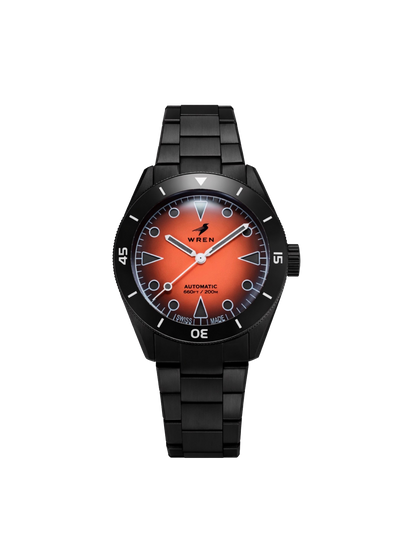
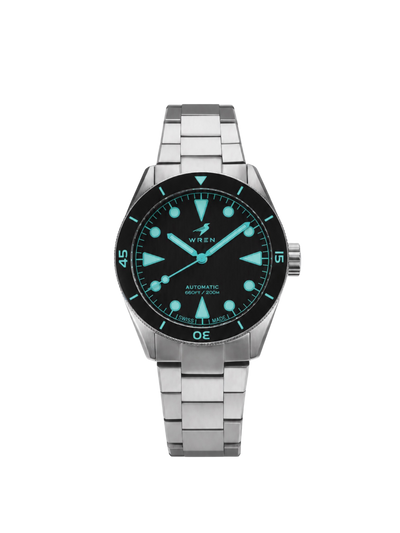
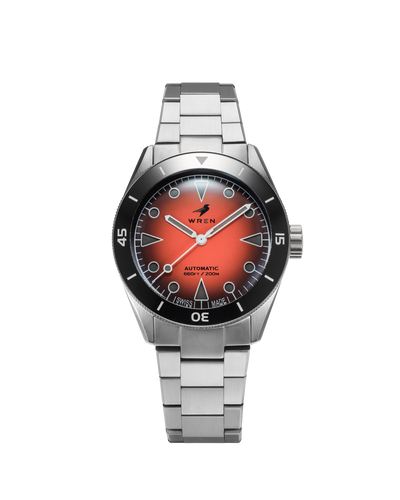
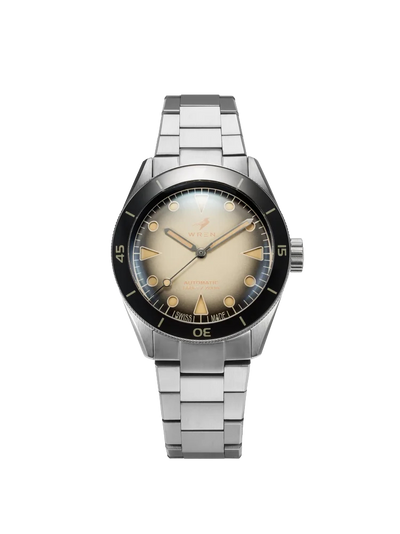
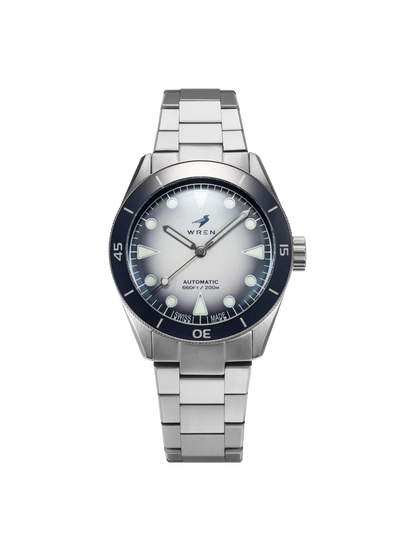
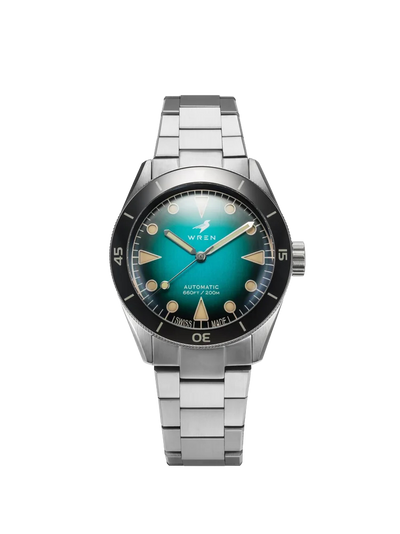
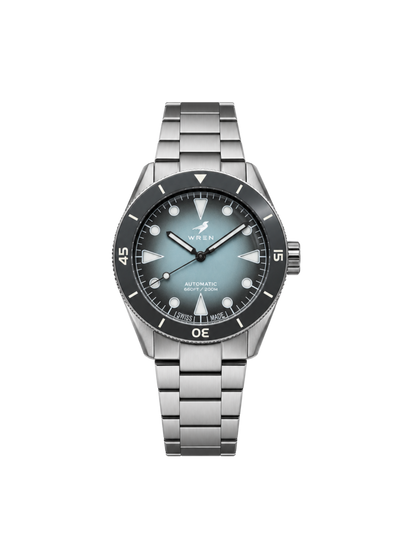
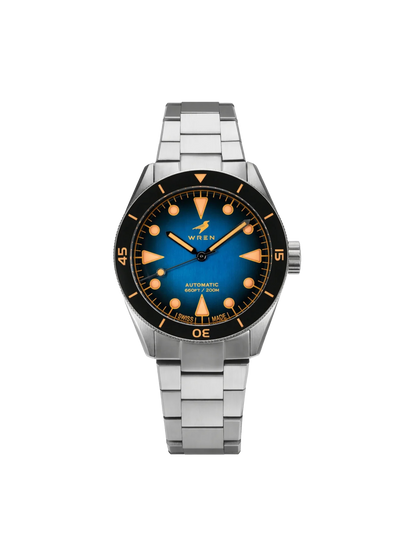
The Diver One and the Diver 38 have box sapphire crystals, double-cut so the inside matches the outside and the view straight on stays clean. The walls are what give both watches their side profile, and they are also most of the reason the Diver 38 is 10.7mm rather than under 10: the case is under 10mm and the crystal is the rest. On the Diver 38 we curved the tip of the seconds hand down to follow the inside of the box, because the hand sits above the bezel inside the crystal and a flat hand would have needed a taller one. On a diver, the bezel sits just below the top of the crystal, which is as much protection as a box crystal gets anywhere.
The Vessel has a faceted sapphire crystal, cut on both surfaces, with the underside shaped as the negative of the top so the dial reads straight through it. It is the most expensive part of the watch to make and the part with the highest scrap rate, and it is the whole reason the Vessel looks the way it does. The crystal is also a bigger share of the Vessel's 10.6mm than on any other Wren.

We do not make a flat-crystal watch. If we ever make a watch where the brief is thinnest possible, that will be the day.
Questions people ask
Is a domed crystal better than a flat one? Neither is better. Flat is thinner, clearer and tougher at the edge. Domed looks warmer and more vintage. If you want a dome, want a double dome.
What is a box crystal? A sapphire crystal with straight vertical walls and a flat or gently domed top, copied from the molded acrylic crystals of 1960s and 1970s sport watches. It adds height and gives the watch its side profile.
Do domed crystals distort the dial? Single-domed ones do, at an angle. Double-domed ones mostly do not, because the inside curve cancels the outside curve.
Does a sapphire crystal chip? Yes, at an exposed edge. It does not scratch in normal use, but a hard knock on a crystal that stands above the bezel can take a chip out of the rim. Flat crystals sunk below the bezel almost never do.
Does the crystal count toward a watch's thickness? It should, and on Wren spec sheets it does. Some brands quote the case only. A box or domed crystal can be a millimeter or more of the difference between two quoted figures for the same watch.
What crystal does the Wren Diver 38 have? A double-cut box sapphire. The Diver One has the same. The Vessel has a faceted sapphire cut on both sides.
Read next
Sapphire crystals explained · Why faceted watch crystals distort the dial, and how the Vessel doesn't · Watch thickness explained