
Meteorite, aventurine, lapis, malachite, onyx. What a stone dial actually is, how each one gets made, what to look for when you buy one, and why the Vessel is the first Wren to get one.
For the first two and a half years of Wren, every dial we made was paint on brass. Sunray, matte, gradient, the ultra-black on the Abyss, and I'm proud of all of them, but they're all the same thing underneath: a stamped brass disc with something applied to the top of it. The Vessel Meteorite was the first time we put a piece of material on the dial instead, and since the Meteorite sold out in two weeks and the questions haven't stopped, I figured it was time to write down what a stone dial actually is, how the different kinds get made, and what you should be looking at when you buy one, from us or anyone else.

What counts as a stone dial
The watch world uses "stone dial" loosely, and I'm going to use it loosely too, because the alternative is pedantry nobody asked for. Strictly speaking only one group qualifies: the hard stones, real minerals cut thin, lapis lazuli, malachite, onyx, tiger's eye, turquoise, and mother of pearl if you want to count a shell. Then there are two materials that get filed under stone dials by everyone, including me, and are not stones at all. The first is meteorite, which is a nickel-iron alloy that happened to form in space, so technically it's a metal dial, and nobody has ever called it that. The second, and the looser of the two, is aventurine, which on almost every watch you've seen is not the mineral but a glass. There is a real stone called aventurine, a quartz with mica flakes in it, but the dial material is copper crystals suspended in molten glass, the eighteenth-century Venetian recipe that got its name because it was discovered by accident, a ventura, and the glass borrowed the name from the stone it resembled. So the category is one kind of stone, one kind of metal and one kind of glass, and they end up on the same shelf because they share the one thing that matters to a buyer: no two dials are the same, and the dial is the thing you look at.
Hard stone: slicing something that wants to break
A hard stone dial starts as a slab of mineral that gets sawn into slices somewhere around a millimeter thick, then ground down further, then polished, and at every one of those steps a percentage of them crack, because the stones people want on a dial are the ones with the most dramatic banding and inclusions, and banding and inclusions are exactly where a stone fails. Lapis has calcite veins, malachite has its concentric growth rings, and the slice has to be thin enough to sit under the hands and over the movement without the watch getting fat, which for a dial with a date window or applied indices means drilling and cutting a material that's already at the edge of what it can take. That's the whole economics of the category right there. The stone is cheap, the yield is terrible, and a finished dial costs what it costs because of the ones that didn't make it. The slice is almost always glued to a brass backing plate, which is the part nobody shows you, and the better makers stabilize the stone with resin before cutting so the fragile bits don't fall out of the pattern.
Meteorite: etching a pattern that's already there
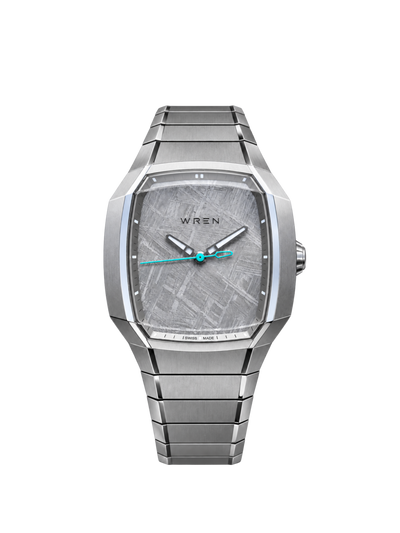
Meteorite is the one I know best now, and I've already written a whole post on it, so the short version. The material is a nickel-iron meteorite, ours comes from Sweden, and the pattern you see isn't carved or printed, it's the crystal structure of the metal itself, which grew over millions of years of cooling in space and can't be reproduced in a furnace on Earth. You get it to show by slicing the meteorite, polishing the slice flat, then treating it with acid, which bites into the two different nickel-iron alloys at different rates and leaves the Widmanstätten pattern standing out in relief. The cutting is the easy part compared to stone, because it's metal and it doesn't shatter, but the pattern decides everything. Two slices from the same meteorite an inch apart can look completely different, and once the dial is cut, etched and plated you're committed to whatever that slice gave you. On the Vessel I went through the dials one at a time, and the ones with the tightest, most even crystal structure went on the watches. If you want to see how the big brands and the affordable ones handle it, Wrist Enthusiast keeps a running guide to meteorite dial watches.

Aventurine: a glass that behaves like a night sky
Aventurine is the loosest interpretation of the three, because it's made, not found. Copper is dissolved into molten glass, the glass is cooled slowly and under control so the copper comes back out as tiny flat crystals suspended in it, and when light hits a slice of that at the right angle every one of those crystals flashes. That's the starfield effect, and the reason it's so hard to photograph is that it depends entirely on angle. A good aventurine dial looks nearly black straight on and lights up when you tilt your wrist. The manufacturing problem is the opposite of stone. Glass cuts fine, but the crystal density varies through the batch, so dials have to be sorted by how much sparkle they carry, and the thickness matters because the depth of the glass is what gives the sky its depth. The cheap way is a thin aventurine veneer on a painted dial. The expensive way is a slice thick enough to see into, which is the version we're building for the Vessel.
What to look for when you buy one
A few things I'd check on any stone dial watch, ours included, and most of them you can check from a photo if the brand is honest enough to show you the dial straight on in flat light.
First, is it a slice or a print. There are a lot of "meteorite pattern" and "aventurine effect" dials out there that are a printed texture or a coated metal, and the tell is that the pattern repeats or sits flat. A real slice has depth; the pattern in meteorite is in the metal, not on it, and the sparkle in aventurine comes from inside the glass, so both of them change as you move. If every photo of a watch shows the dial from exactly the same angle, that's usually why.
Second, look at the edges. Where the dial meets the chapter ring, the date window if there is one, and the holes for the indices, that's where stone chips and where a lazy maker hides the chips under a thick printed ring. A clean cut edge on a stone dial is the single best signal that the rest of the work was done properly.
Third, ask whether the brand picked the dials or just received them. On a painted dial it doesn't matter, every one is the same. On a stone dial the difference between a good one and a dull one is the slice, and somebody either sorted them or didn't.
And fourth, the one almost nobody talks about, look at what's on top of the dial.
Why the crystal matters more on a stone dial
I didn't fully understand this until we built the Vessel. A sapphire crystal with any shape to it, a dome, a bevel, a facet, bends the light coming off the dial, and on a flat painted dial you mostly don't notice, because there's nothing in the dial for the distortion to grab. On a stone dial there's pattern everywhere, and every bit of that pattern gets pulled and smeared wherever the crystal changes thickness. I've seen expensive meteorite watches where the pattern goes soft in a ring around the edge of the dial, and that's not the dial, it's the crystal.
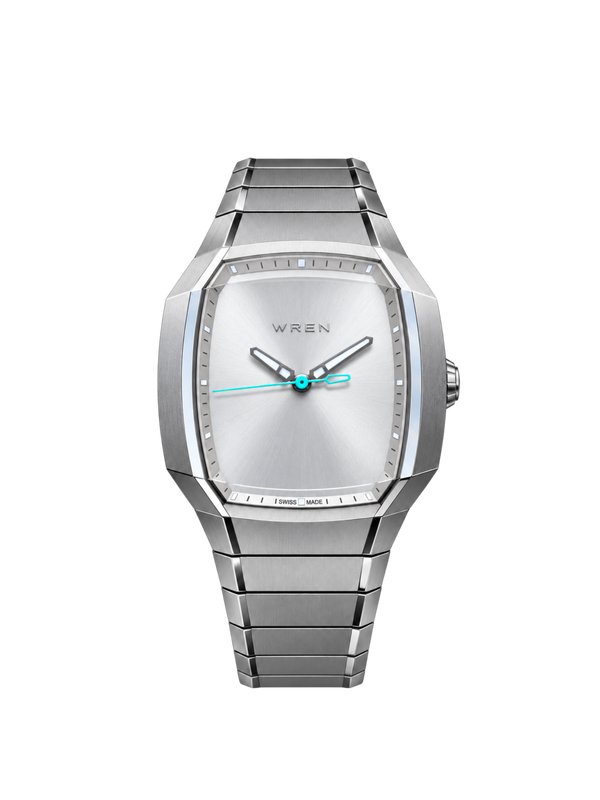
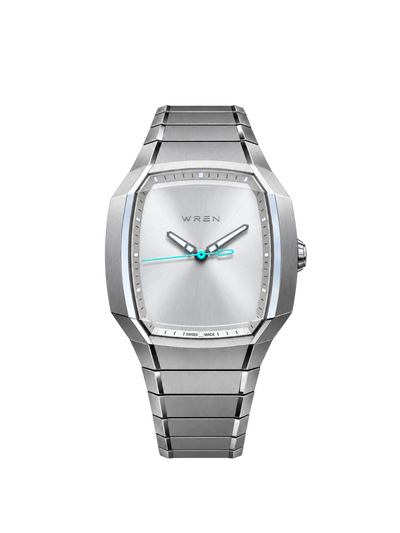
The Vessel's crystal is faceted on top, the two facets at twelve and six, and the honest first version of it had those facets on top and a plain curved underside, which is how most faceted crystals are made, and when you put a meteorite dial under it the pattern bent along the facet line. That was the version I rejected, and the reason the Vessel's crystal is cut again underneath, with the inner facets following the outer ones, is that it was the only way to get the facets we wanted and have the meteorite read true all the way to the edge. It cost us a 95 percent scrap rate on the first run and a crystal that's more expensive than the movement, and I'd do it again, because there is no point putting a four-and-a-half-billion-year-old pattern on a dial and then blurring it. If you're buying any stone dial watch with a shaped crystal, that's the question to ask: is the dial flat and clear right out to the edge, or does it go soft.

Why the Vessel was first
People have asked why the first Wren stone dial went on the Vessel and not a diver, since the divers are what we're known for. The answer is that I wanted the first one to be on a special watch, the one designed to look like a tiny spaceship on your wrist, and a dial that came from space was the obvious thing to put in it. It also had to be the Vessel because of that crystal. I wouldn't have been happy putting meteorite under anything that distorted it, and the Vessel is the only crystal we make that doesn't.

The Meteorite is gone, all 150, in fourteen days, which I still find hard to believe. The Steel Sunray is the Vessel you can still get, same crystal, same case, same bracelet, and if you want the dial that plays with light the way a stone does without being one, that's the watch. And the next stone dial is already in work: the Vessel Aventurine, the thick-slice version I described above, which will be the second Wren with a material dial and the first with a sky in it. Sign up on the Vessel page and you'll know before anyone else does. I haven't ruled out a meteorite diver either. That one's a question of finding a crystal I'm happy with.