
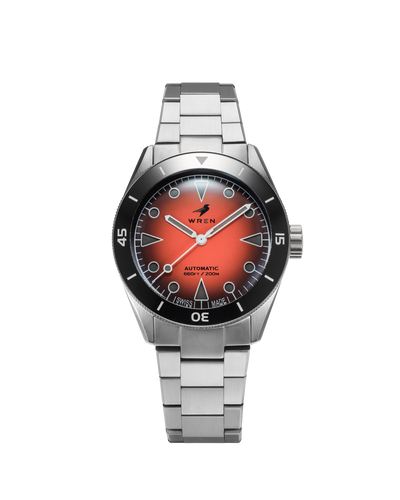
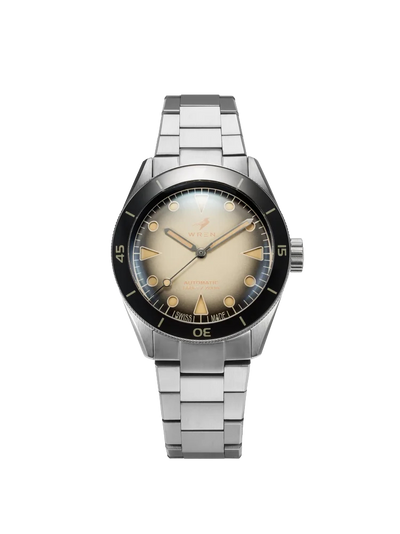
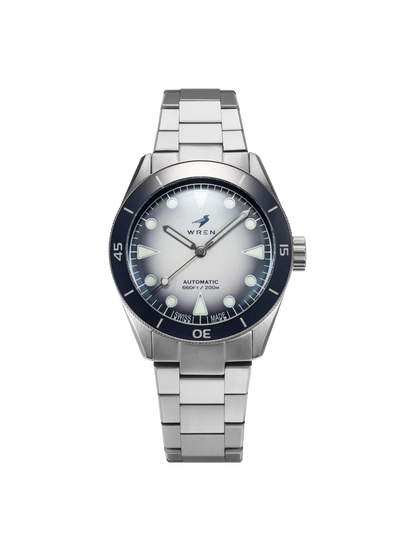
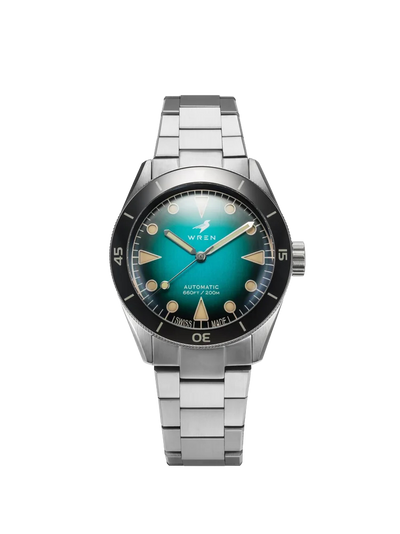

What the letters and numbers on a lume spec mean, which colors glow brightest and why, what the grade actually buys you, and why every Wren diver since the Snow has had the whole bezel scale lumed.
Lume is the one spec where the number on the sheet tells you almost nothing. "Super-LumiNova" covers dozens of pigments at several grades, two watches with the same words on the listing can glow very differently, and the one that looks brightest at midnight is often the one that looks plainest at noon. This is how to read it.
What lume is
Modern lume is strontium aluminate, a ceramic powder doped with a little europium and dysprosium, mixed into a binder and painted or filled into the hands, markers and bezel. Light charges it, mostly the ultraviolet end of daylight, and it gives that energy back slowly as visible light over hours. There is nothing radioactive in it and nothing that wears out; it will charge and discharge for the life of the watch. Swiss Super-LumiNova is the pigment made by RC Tritec in Switzerland under license from Nemoto, the Japanese company that invented it in 1993.
Color is the first number
The pigment's natural color is pale green in daylight and green in the dark. That is C3, and it is the brightest thing you can put on a dial. Everything else is C3 with something added, and everything you add costs light.
| Pigment | Daylight | In the dark | Brightness |
|---|---|---|---|
| C3 | Pale green | Green | The reference. Brightest available |
| BGW9 | White | Blue-white | A little under C3. The usual choice when the markers need to read white by day |
| BL (blue family) | White | Blue | Similar to BGW9, bluer glow |
| Tinted colors (cream, orange, gray, aqua) | The named color | Green or blue, shaded by the tint | Noticeably lower. The colorant absorbs light the pigment would otherwise emit |
| Vintage shades (deep cream, "old radium") | Beige to tan | Dim green | The lowest. Chosen for the look, not the glow |
The rule is simple: the closer a lume is to white or pale green in daylight, the brighter it is at night. A colored lume is a design decision that spends some brightness to get a look.
Grade is the second
Grades run from Standard through A up to X1. They do not change the color and they barely change how bright the lume is in the first minute. What they change is how fast it fades. The higher grades hold their light longer into the night, and X1 holds it longest. A watch that is still readable at 4am is running a high grade; one that was blinding at 11pm and gone by 2am usually is not. X1 is the top grade, and it is what we specify for our watches.
What we do, and the trade we make
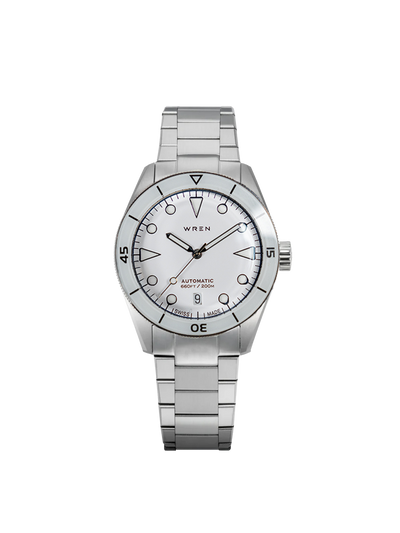
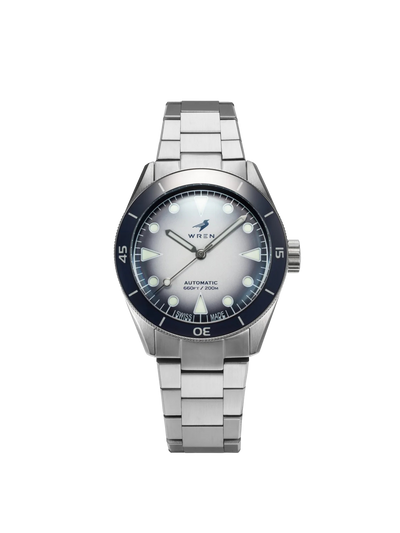
Every Wren diver uses top grade Swiss Super-LumiNova on the hands, the markers and the bezel. Where the lume is white in daylight, which is most of the range, it is as bright as a white lume gets.
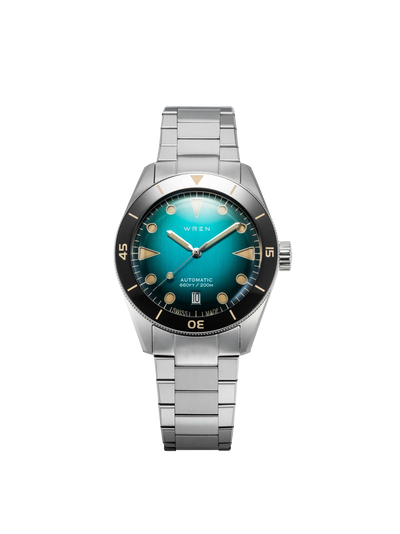
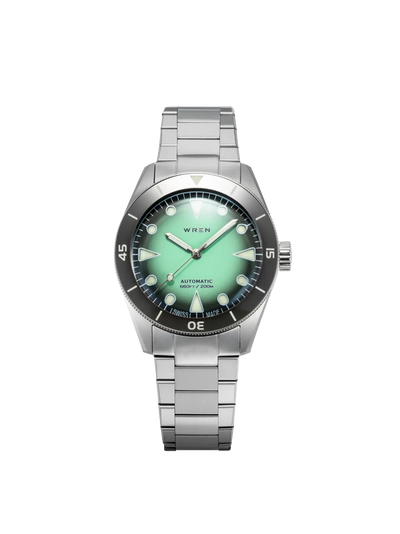
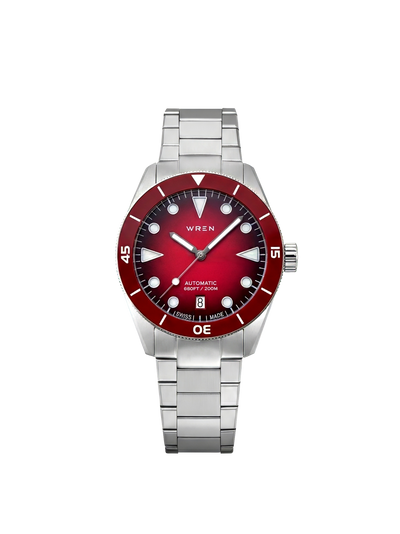
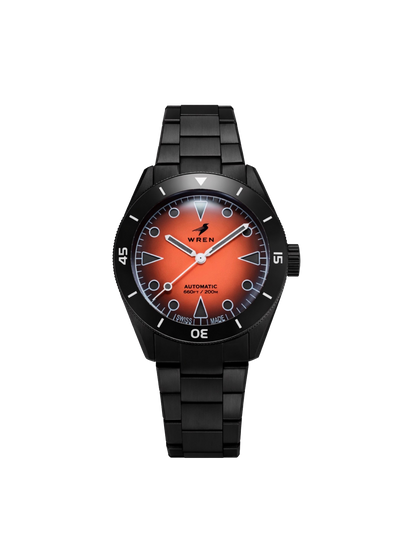
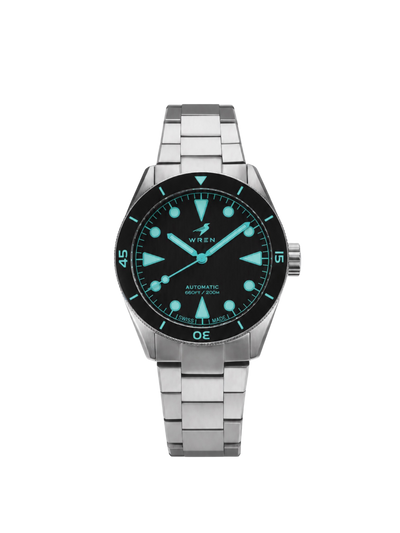
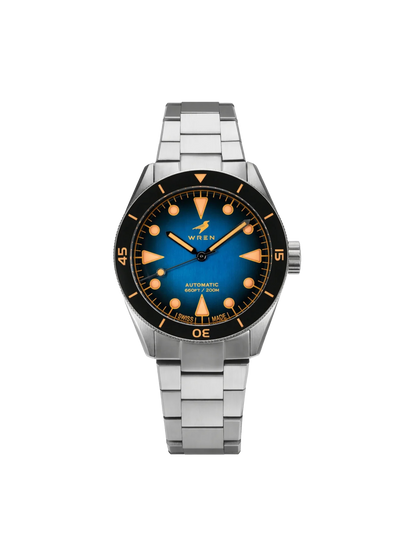
Where it is not white, we chose the color knowing the cost. The Diver 38 Aqua has cream markers because cream on that blue was the right look. The Diver One Titanium Dusk has orange. The Obsidian and the Magma have gray. The Abyss has aqua, because the whole watch is built on the idea that the only thing you see is aqua. All four glow well. None of them glow as hard as the white, and we would rather say that plainly than pretend the color came free.


Why the whole bezel
On most dive watches only the pip at twelve is lumed, and that is where we started. The first Diver One had a sapphire bezel with a lumed pip and nothing else. When the Diver One Snow came out we lumed the full 60-minute scale on the bezel, and we have not made a watch without it since.


On the ceramic bezels of the Diver One, Diver One Titanium and Diver 38, the numerals and the minute track are filled, so the markings glow and the surface between them stays dark. On the Diver 38 Mad we went further and lumed the entire bezel, which is only possible with a sapphire bezel because the lume has to sit under a surface you can see through. In the dark the Mad's bezel is a solid ring of light with the scale cut out of it.
The practical reason is that a bezel you cannot read in the dark is decoration. The other reason is that it looks spectacular, and we build watches we want to look at.
How to get the most out of any lume
Charge it in daylight, not under a lamp. A minute by a window does more than an hour under a bulb, because the pigment charges on ultraviolet and most indoor light has very little. A UV flashlight charges it fully in seconds, which is how most lume photographs are taken, ours included. And judge lume after half an hour, not in the first thirty seconds; that is where the grade shows and where the difference between watches is real.
Questions people ask
What is BGW9? A Super-LumiNova pigment that is white in daylight and glows blue-white in the dark. It is the standard choice when markers need to look white on the dial, and it is close to C3 in brightness.
Is C3 brighter than BGW9? Yes, slightly. C3 is the brightest pigment made; BGW9 gives up a little brightness to be white instead of pale green by day.
What does Grade X1 mean? The highest grade of Swiss Super-LumiNova. The grade does not change the color or the initial brightness much; it means the glow fades more slowly, so the watch stays readable longer into the night.
Why is colored lume dimmer? The pigment is naturally pale green. Making it cream, orange, gray or any other color means adding a colorant, and the colorant absorbs some of the light the pigment would otherwise emit.
Does lume wear out? No. There is no chemical change when it charges and discharges, so it keeps working for the life of the watch. Old watches with dead lume are using older materials, or radium and tritium, which do decay.
Which Wren has the brightest lume? The watches with white daytime lume. Among them the Diver 38 Mad is the one to see in the dark, because the entire sapphire bezel is lumed rather than just the scale.
Sources
Pigment chemistry, the C3 and BGW9 figures and the grade descriptions are from the Super-LumiNova entry on Wikipedia and RC Tritec's published material. Wren bezel and lume details are from our own FAQ and product pages. If you think we have something wrong, email hello@wrenwatches.com and we will correct it.
Read next
How to set a dive bezel, and three things it is for besides diving · Why watches scratch so easily, and why every Wren is coated