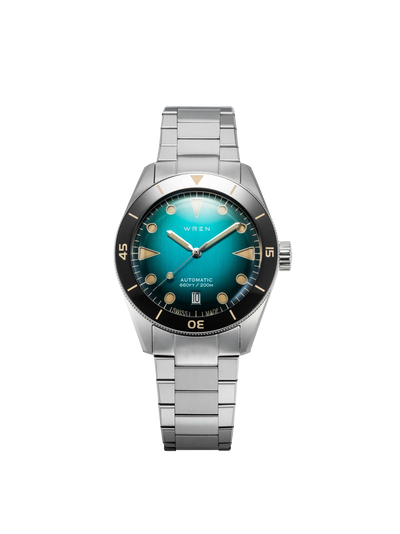
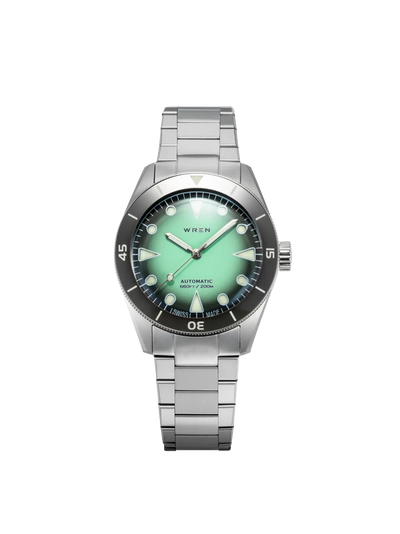
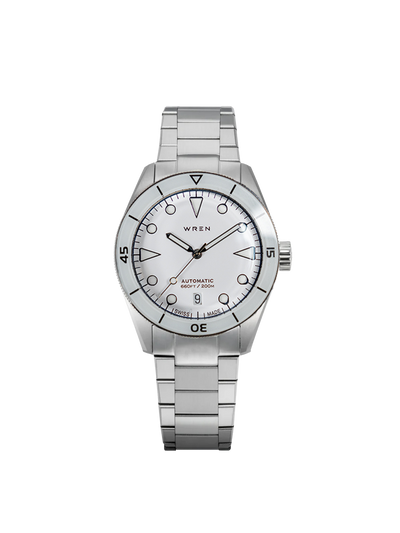
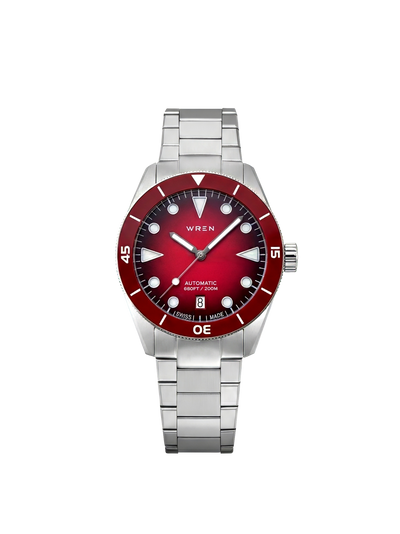
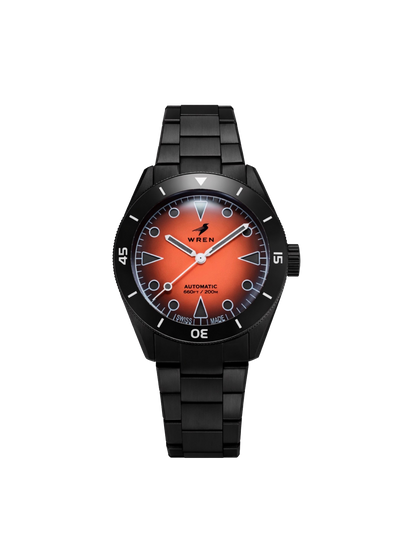
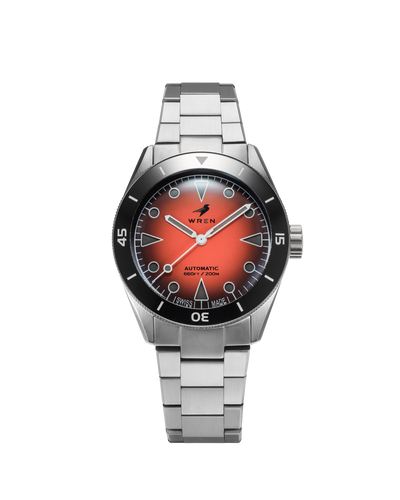
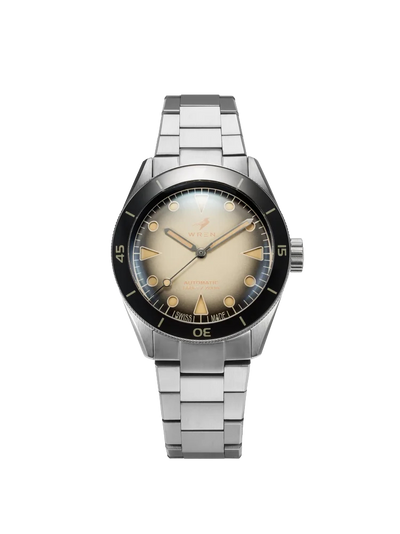
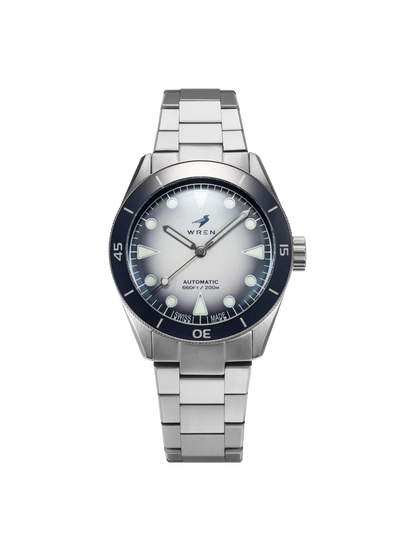
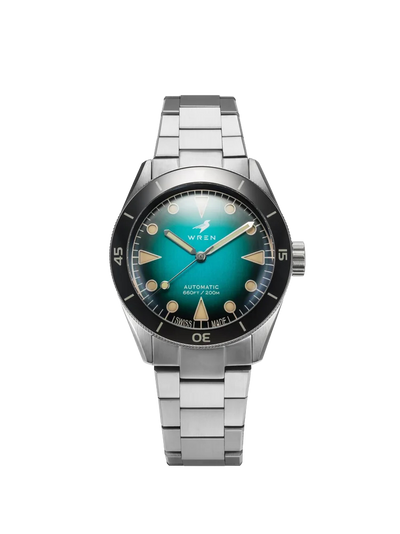
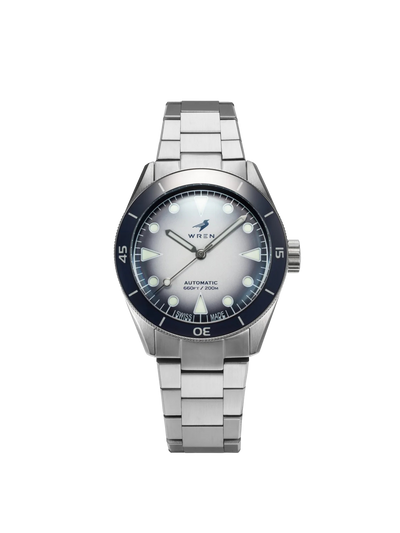
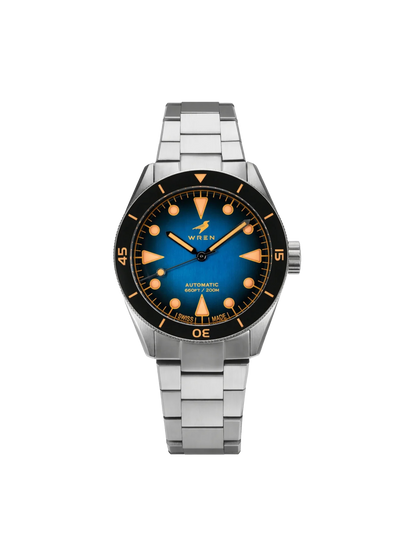

Every Wren diver has a sandwich dial. Here is what that means, why it matters more on some watches than others, and what to look for.
A sandwich dial is two plates instead of one. The top plate has the hour markers cut clean through it. The plate underneath is coated in lume. Stack them, and the markers you see are not painted on the dial or glued to it; they are holes, and the glow you see at night is the lower plate showing through.
That is the whole idea. It sounds simple, and it is, but it changes how a dial behaves in three ways that are easy to see once you know to look.

Where it came from
Panerai gets the credit, and deserves it. In the late 1930s they were building watches for Italian navy divers who needed to read the time underwater, at night, with no light. The answer was to pack the markers with as much luminous paste as physically possible, and the only way to hold that much material in place was to cut the markers out of the dial and fill the cavity from below. The sandwich dial was a legibility solution before it was anything else, and that is still the best way to think about it.
What it does to the lume
A printed marker holds a layer of lume maybe a tenth of a millimeter thick. A sandwich marker holds a well of it, as deep as the top plate, and the lume sits in a recess that is protected on all sides. More material means a brighter glow and a longer one. It also means the glow has edges. A printed marker glows as a soft blob; a sandwich marker glows as a clean shape with a hard outline, because the top plate is masking it. On a dive watch that is the difference between knowing roughly where twelve is and reading the minute hand against it.
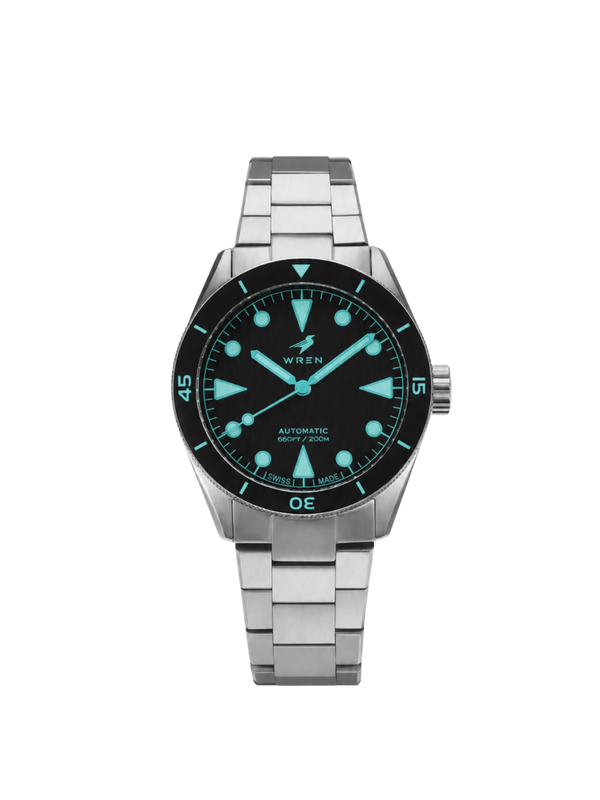
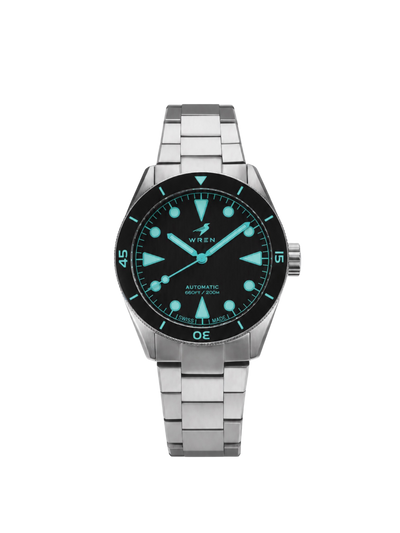
On our divers the markers are cut through and filled with Swiss Super-LumiNova, and the bezel scale is lumed as well, so the whole watch reads as one system at night rather than a dial that glows and a bezel that doesn't.

What it does to the surface
This is the part most people miss. Anything applied to a dial sits proud of it. Applied indexes cast a shadow. Even thick printing catches light at a different angle than the dial around it. A cut-through marker does the opposite: it sits below the surface, and the dial itself stays flat and uninterrupted right up to the edge of the hole.
That matters on any dial with a finish worth looking at, and it matters enormously on one that is trying to disappear. It is the reason the Diver One Abyss works at all. Musou Black absorbs 99.4 percent of the light that hits it, which is the point, but a material that hides its own surface has a problem the moment you put something on top of it: the applied marker shows you exactly where the surface is, and the illusion is gone. Ultra-black dials from other brands are usually blank for exactly this reason. Because every Wren diver dial was already a sandwich, we could cut the markers through the plate and let the aqua lume show from beneath, with nothing standing on the black. The result is the darkest dial you can actually read. We did not invent the construction for that watch. It was already how we build dials, and it happened to be the right answer.

What it does to depth
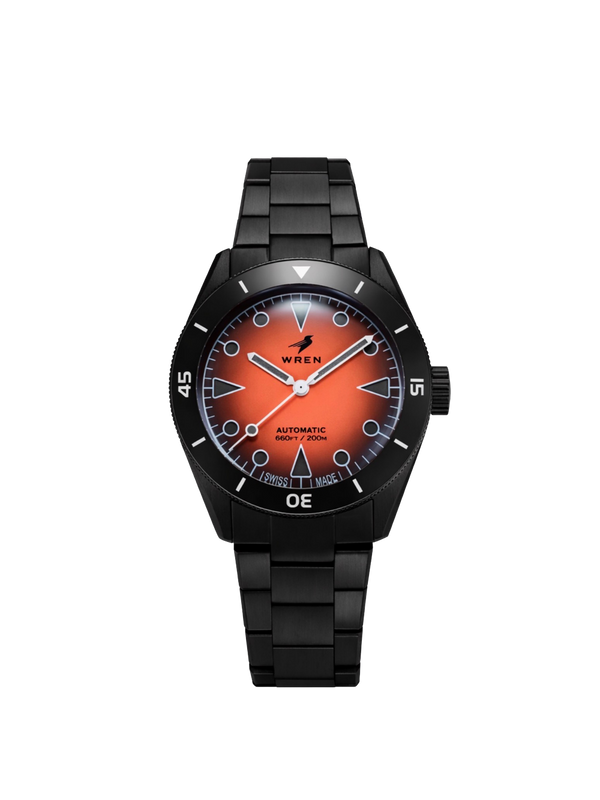
A sandwich dial has a third dimension that a flat dial does not. Tilt the watch and the marker walls catch the light; the lume sits visibly below the plane of the dial. On a fumé or gradient dial that layering adds to the effect, because the color is shifting across the surface while the markers sit beneath it. It is subtle in photographs and obvious on the wrist, which is one reason sandwich dials tend to convert skeptics in person.

What it costs
More than a printed dial, and it shows up in the details rather than the headline. The top plate has to be cut precisely, which means stamping or laser cutting to tight tolerances, and the cut edges have to be finished so they do not look rough under the crystal. The two plates have to register perfectly; a lower plate that is off by a fraction of a millimeter shows as a marker with a thin crescent of lume on one side. And the lume has to be applied evenly across the whole lower plate, not dabbed into markers one at a time, because any variation reads as one marker brighter than its neighbor.
None of that is exotic. It is just more steps, and more places for a cheap dial to go wrong, which is why a well-made sandwich dial at a sensible price is rarer than it should be.
What a sandwich dial is not
It is not the same as a lumed marker. Plenty of watches have bright lume applied on top of the dial. It is not the same as an applied index with a lume insert, which is a marker glued to the dial with a shallow channel of lume in it. And it is not automatically better; a dress watch with polished applied batons is not improved by cutting holes in it. The construction earns its place on a tool watch, where legibility in the dark is the job, and on any dial where the surface itself is the point.

How to spot one
Look at the markers from an angle. On a sandwich dial you will see the wall of the cut, a slight shadow inside the marker, and the lume sitting lower than the dial. The marker edge will be crisp. At night the shapes will be sharp-edged rather than fuzzy. If the markers appear to sit on the dial or stand above it, you are looking at print or applied indexes.
Every diver we have made, from the first Diver One Aqua to the Abyss, is built this way. The Vessel is the one exception, and that is a story for another post. It is one of the quiet decisions that does not show up on a spec sheet and makes a difference every time you look at the watch in the dark.